Interview with Cappo, a seminal figure in UK hip-hop, on the Plague label.
Cappo is a veteran UK rapper known for his dense lyricism, introspective storytelling, and uncompromising style. Hailing from Nottingham, he’s carved a distinct space in underground hip hop.

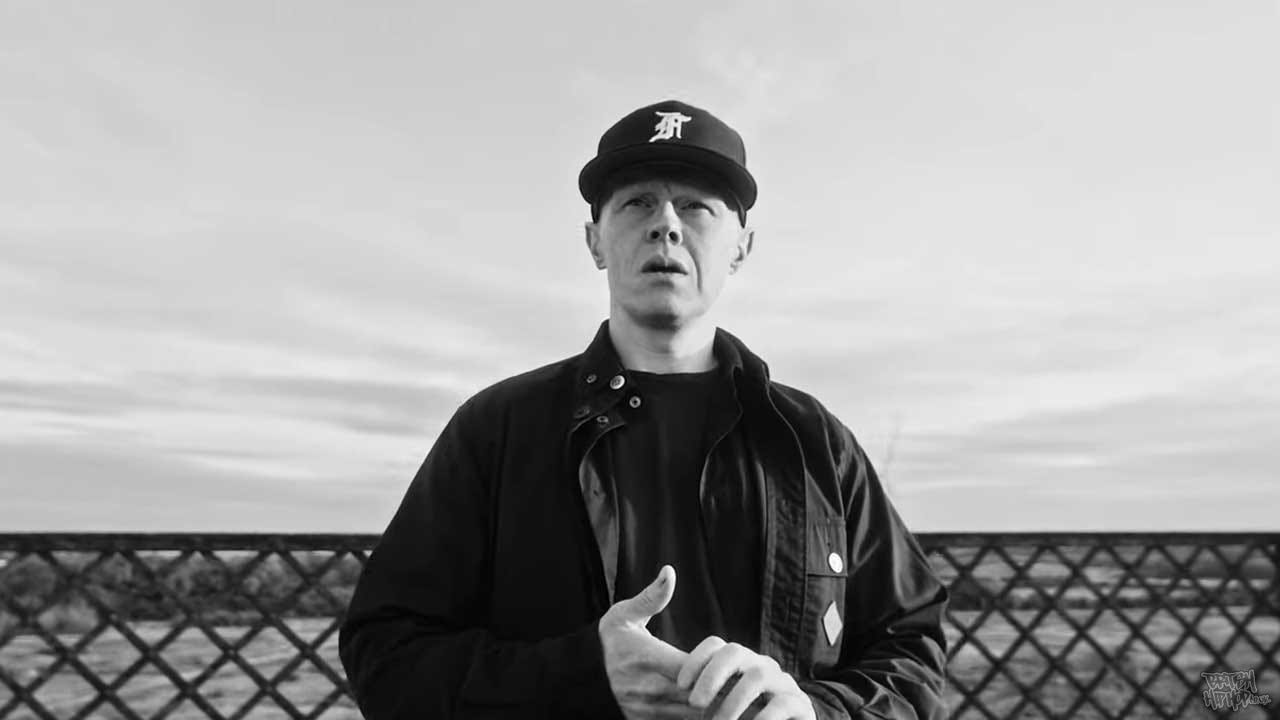
Cappo, born Paul Stephen Adey, is a seminal figure in UK hip-hop, renowned for his intricate lyricism and deep engagement with literature and philosophy. Hailing from Nottingham, he began his journey in hip-hop as a graffiti artist before transitioning to rapping in the mid-1990s. His debut album, Spaz the World (2003), released on Zebra Traffic, is considered an underground classic, showcasing his dense rhyme structures and introspective themes. However, my knowledge of Cappo comes from the album S.T.A.R.V.E. by the UK label Plague — an album full of great lyrics and sounds.
S.T.A.R.V.E. tells a raw and personal story, following a working-class man in Nottingham as he struggles with mental health, heartbreak, and addiction. What’s striking is how the live performance transforms the album’s emotional weight into something even more immersive — almost theatrical, like an art installation that brings Cappo’s complexity as an artist into an entirely new dimension. See this video below:
The video was filmed on the 6th of September 2024 at The Bonington Gallery in Nottingham by Honey JD, with projection images by The Theorist.
S.T.A.R.V.E., the first part of the CAPstone Trilogy, introduced a powerful narrative arc that continues with the upcoming LP Houses — the second installment in the trilogy, recently released on the Plague label.
I was introduced to Cappo by Danny, the owner of Plague, and had a great conversation with him about his music and influences. We talked about films, literature, hip hop, and his PhD at Nottingham Trent University, titled ‘Nothing New Under the Sun’: Literary Allusion, Intertextuality, and Lyrical Performative Stylistic Allusion in Hip Hop Lyricism, which he completed for his Doctorate in Creative Writing.
- How did your collaboration with Plague come about?
Me and Danny (Bane), the label owner of Plague Records, have known each other since around 2008 when I visited Leeds to perform a show that Bane was promoting. We didn’t stay in regular contact, but at some point, a couple of years ago, Bane reached out to me to ask if I would consider putting out a project on his label. Bane’s contact felt serendipitous, as I was actively seeking a home for one of the LPs taken from my recently completed PhD trilogy at the time. This LP was S.T.A.R.V.E. Bane really locked in with my ideas for S.T.A.R.V.E., and his candid and honest approach to releasing music was really refreshing. We stayed in contact and kept exchanging ideas about the LP. Bane made it clear about his passion for the PhD trilogy from the start. He was open and forthright about his intentions for the project, and that’s when I knew that I could release the full PhD project (CAPstone Trilogy) with him. It was clear that he felt just as strongly about it as I did. We have kept an honest and open artistic and business relationship ever since. S.T.A.R.V.E. – as with the other two LPs taken from CAPstone – felt very different from my past releases, both thematically and conceptually. The uniqueness of LP was compounded by the fact that it had been complete and in circulation (with peers and colleagues) for several years, so by the time me and Bane spoke about it, it was pretty much ready to go (after the added expertise of IRN MNKY’s mixing/mastering). This meant that we had plenty of time to plan and discuss ideal modes of promotion for the LP, both before and after its release. In addition to the candid nature of S.T.A.R.V.E. (the LP is deliberately flawed and problematic), I’m really proud of the post-release element of the album. The way we approached promoting the LP has helped to keep it fresh in people’s minds, which is a very important aspect of modern music promotion. Me and Bane have spared no effort in exploring ways in which we can transcend traditional music promotion methods, especially in relation to the idea of a professional musical existence in the ‘post-digital’ age. For example, since its release, in addition to physical elements/merch, S.T.A.R.V.E. has been the subject of an endurance performance, a gallery installation, a spoken word series, an academic paper, a journalistic article, and also discussion point for psychology lectures. In addition to this, S.T.A.R.V.E. is also manifested digitally on streaming platforms, as a podcast documentary, a short film, and we now have plans to turn it into a play and audiobook.
The fact that I’m writing towards your Substack about the LP almost 6 months on from its initial release is testament to my belief in the longevity of the project, and my own, newly acquired, long-term approach to releasing music. I have absolutely no intention of slowing down, or ceasing promoting the project, as I feel it is of genuine benefit to people, and will form the core of my musical legacy.
- Your sound is very cinematic and layered. I find the voiceovers particularly fascinating, as they feel interwoven with your lyrics much like in film. Do you use live instrumentation, or do you mainly work with samples? Do you have any favorite samplers, drum machines, or DAWs?
I have used an MPC (an Akai MPC 2000 XL in the past, and currently an MPC X) as my music workstation since beginning my career. My artistic process is exclusively sample-based, and highly formulaic. I was lucky enough to be born at a time when digital sampling was becoming more and more commonplace in music, and I took this technique and ran with it. Personally, I feel that digital sampling in music has been the single most empowering tool of any artform throughout the last century. It has enabled many great minded individuals to create textured layers of sound and sonic tapestries that may never have existed without sampling, and certainly not been generated through instrument performance alone (the same applies for AI-generated music in the future). Regarding my use of film vocal samples on S.T.A.R.V.E. (and the full PhD trilogy), it was always my intention to contribute to the cerebral aspects of rap lyricism/songwriting that have appealed to me since immersing myself in the art form as a young man. For the trilogy, I made a conscious effort to push (or at least demonstrate clearly) rap’s capacity for emotional and intellectual stimulation. This is not to say that I am doing something entirely original on the project. Rather, I’m trying to clarify that rap music has been engaging in this process for at least thirty years. Since rap artists like Rakim and Nas began to increase the level of complexity in rap, and develop the emotional depth of lyricism within the art form, there have been many examples of rap in combination with production/instrumentation that have formed intricate and intriguing mosaics of sound to evoke original/unique thought/emotional states (take Prince Paul as an example of the past, and MIKE in the present). I wanted to do the same, but through a series of vocal samples that combine to create a quasi-conscious form of interrogation. I wanted to take my music beyond commonly covered ground, and prompt the listener to have an internal discussion with themselves during the project. I wanted to disturb them, in a way, in order to get into their heads, just as mental illness gets into our heads. Mental illness is at the core of S.T.A.R.V.E.’s narrative. Several people have told me that they have felt personally implicated by the voices (film vocal samples) featured on S.T.A.R.V.E., as if they were being spoken to directly, ultimately creating a sense of being personally attacked. This was a conscious technique I incorporated into the LP, by fitting alternate (sampled) voices intricately between my rhyme patterns, the samples began to feel like voices in the speaker’s head. These voices seem to trigger the protagonist’s subsequent thoughts and emotions, and govern their next actions and words (in a sporadic, subjective way), spurring them on towards a further decline in mental health, and a gradually degrading world view.
-Do you prefer writing lyrics to pre-made beats, or do you work with producers in a more collaborative, back-and-forth process to shape the sound?
For the majority of my career I have written to pre-made beats, and I rarely work with producers in a collaborative-creative process. The whole of the CAPstone project was written in solitude, for example. The only exception to this rule is when I work with VVV (Juga-Naut and Vandal Savage). Jugz and Savz are the only artists I’ve worked with extensively on collaborative material, in which we hit the studio and write and record together. It’s always an honour and a privilege to lock in with them in a studio environment. Both of them are immensely gifted lyricists, but also amazing human beings with incredible artistic sensibilities. We also share a unique sense of humour, as noted by the music videos we create whenever we release records together. My preference for writing to pre-made material stems again from my love of sampling. Whenever sampling music, I rely on the preconceived mood of the record/band/artist I am borrowing (sampling) from to help shape/evoke my own ideas/feelings regarding lyrics, concepts, and/or topics. Without this initial emotional trigger, or ideological starting point, I often would not know where to begin. The same rule applies when I’m writing to another producer’s music/beats. The mood, or vibe of the beat will hit me almost instantaneously, and I will unconsciously begin writing/developing ideas from there.
For my next project, I intend to try incorporating collaboration into the mix and proactively work in depth with musicians to create a piece that incorporates sampling with live instrumentation (similar to my live performances of the Canon LP. but on a more expansive level).
- S.T.A.R.V.E. is deeply rooted in literature (Knut Hamsun, Bukowski…), philosophy (Homer), and cinema (Gaspar Noé, Adrian Lyne, Paul Schrader), according to the description of the album. I recently watched Jacob’s Ladder and Enter the Void, both films explore life and death and seem to suggest that in life, we must choose our path. How do you go about translating these influences into your lyrics?
A lot of the artists/authors you mention are individuals I aspire to emulate through assimilation. They are people who I would deem as being deeply intellectual and candid, and at times also be noted as provocateurs. I set my own standard of recent works against these kinds of people. It should also be said that all of the above are men. I am aware of this issue regarding my artistic inspirations for the CAPstone project, and I am actively working to re-address this imbalance in my future projects. I didn’t view Jacob’s Ladder, or Enter the Void in the same way as you did. I saw both of these narratives as being predominantly about an individual trapped on a predestined path, rather than a path that eventually leads to choice. I do agree that both narratives speak loudly to me about life and death, and the amorphous space between. Jacob’s Ladder has been a particular inspiration for me throughout my adult life, especially in relation to my experiences of mental health decline, and feelings of being swept along by life on a haunting tide without autonomy. My uncle once said that many people (if not all) experience a sense of misalignment with life (falling out of line with hope and fate) at one stage or another in their lives, and Jacob’s Ladder really illustrates that for me. Sometimes our ghosts return to haunt us, and we are unable to gain a foothold, or grasp on reality, in order to climb out of the physiological ravines we find ourselves in. A text that relates strongly to this subject matter, that I came across too late to be included in S.T.A.R.V.E. was Fuminori Nakamura’s The Gun. That novel feels very claustrophobic, and unnerving to me. The same goes for Plath’s The Bell Jar. I had audio samples ready for use on S.T.A.R.V.E. that were taken directly from The Bell Jar, but I couldn’t find the adequate time/space to incorporate them on the LP. I’ve been looking into the biblical original story of Jacob and the ladder recently, and this is also fascinating. I feel there is still more for me to learn regarding this narrative, and I look forward to exploring it artistically in the future.
Incidentally (and for intentional intertextual purposes), the final instalment of the CAPstone project, ITO, references another philosopher, Meister Eckhart. Eckhart’s ideas of Hell on earth are explored in Adrian Line’s Jacob’s Ladder, and also ‘Greene’, track five from ITO. For ‘Greene’, I have digitally quoted (sampled) the voice of literary giant Julia Kristeva, who in turn verbally quotes Eckhart’s ideas of theology.
- I've read Inferno multiple times, and it has truly inspired my life, especially during lockdown. Being in Melbourne during the world’s longest lockdown deeply affected me, but Inferno helped me stay positive.
You mentioned Dante in the song Terrace 3 Void. Did Inferno, particularly any specific cantos or circles of Hell, directly influence the journey you depict in S.T.A.R.V.E.?
I can’t claim to be very well-versed in Divine Comedy, but Dante’s notion of seven levels of purgatory was very much an inspiration for S.T.A.R.V.E.’s narratological structure, and track list. ‘TERRACE III’ is the first of a series of candid acapella sketches on the LP that act as brief insights into the S.T.A.R.V.E. protagonist’s gradual descent into a form of self-imposed mental purgatory. Each ‘Terrace’ piece taken from the LP represents a circle, or level of descent into hell. During ‘Purgatorio’, the second part of Dante’s trilogy, Dante imagines Purgatory as being divided up into seven terraces, each one corresponding to a vice; a psychological state of the soul depicted as levels on a mountain. In opposition to Dante’s narrative (illustrating his climbing of the mountain towards ‘paradise’), S.T.A.R.V.E. attempts to show the protagonist’s struggle and gradual descent, towards a form of eternal damnation. The terrace series also reveals a reasoning behind S.T.A.R.V.E.’s protagonist’s name, (‘P’). Early on during Dante’s journey, at the second stage of ‘ante-purgatory’, an angel guarding the gates of Purgatory Proper carves Dante’s forehead with the letter “P” seven times.
Despite Dante’s importance to the LP, I don’t think that I actually ever verbally reference them by name on the album. Instead, I used a sample from Ralph Ellison’s Invisible Man, in which Ellison’s protagonist references Dante and the seven circles of hell in relation to their falling into a musical reverie. This is what I love about the intertextual techniques employed on the S.T.A.R.V.E. (and the PhD trilogy), the level and depth of meaning is increased tenfold when the reference/allusion is taken from a sample itself. It’s very cyclical.
- With your Master’s in Creative Writing and your PhD focused on literary allusion in hip-hop; specifically the techniques and literary devices rap artists use to convey personal trauma. Do you see rap as a form of high literature? How has your academic research influenced your approach to lyricism, and do you think hip-hop receives the literary respect it deserves?
It wasn’t until relatively late in life that I discovered what might be deemed as ‘high literature’. I was well into my thirties before I read authors like Jean Rhys, Ernest Hemingway, Ralph Ellison, James Baldwin, Toni Morrison, Cormac McCarthy, Patti Smith, Haruki Murakami, Sylvia Plath, etc. All of the above I deem masters of conveying personal trauma in written form. Before this, I relied mainly on rap music for my literary inspiration, and so I gained a unique understanding of how trauma and vulnerability is articulated through verse and performance, before learning how an author/poet might translate similar subjects. Soon after I began reading in earnest, I started making links between rap lyricism, poetry, and fiction. That’s when I truly realised what rappers were doing; the subtle ways in which they were manipulating language forms, drawing on each other’s words for empowerment, and pushing literature forward through innovation. In direct answer to your question, yes, I do think rap is high literature, but I think there is a definite separation between musical and literary worlds. I also think that a better description for high literature regarding rap is ‘dopeness’. I have to be careful to ensure that rap is noted in its own vernacular when it comes to praise, otherwise I run the risk of unconscious cultural and artistic bias. Rap is always an art form that stands on its own terms, and is inherently a weapon against institutionalisation, or elitist art forms. I think rap music is also separate from other literary worlds due to its overt nature, in the same way that much music is. Another main difference between rap and creative writing, or poetry and fiction, is that rap music is made to be heard, and not necessarily read. Here lies a vast difference, one that I’ve difficult to articulate adequately in the past:
Whereas historically, an author/poet might dwell at will upon any subject they deem fit - any aspect of life, be it joy, pain, high intellect or base emotion - and plunge the depths of that subject to their heart's content without scrutiny (this might at times be graphic, problematic, controversial, material, etc., see authors such as Bukowski, Brett Easton Ellis, and even Frank Miller in From Hell, for examples), rap music - due to its overt nature and cultural standpoint - is much more susceptible to interrogation, scrutiny, and negative perception. Whereas authors can often use their craft to hide behind preconceived messages and meanings buried in scenes and in character traits, etc., rappers often don’t have that solace. I think high literature might be better known as ‘hide’ literature (as the adage goes, if you want to hide something from the masses, put it in a book). Even now, after over a decade of reading authorial giants, and consistently making attempts to demystify the literary process, it still intrigues me how an author can mine the lowest depths of the soul, and explore the darkest elements of the human condition often without consequence or scrutiny.
It’s just not the same for a rap artist, as the common misconception is that rappers must remain authentic to themselves at all times, and only speak truths from a singular, highly individualised, perspective. I’m sure this will change over time. Artists like Sticky Fingers, Kendrick Lamar, and Billy Woods have been renegotiating this trope for some time.
- How did you translate your poetry, intertextuality, and literary allusion into lyrics, exploring themes of downfall and isolation; while shaping a sound that reflects genuine lived experience? Do you approach songwriting more like a novelist, crafting a full narrative arc, or do you build tracks around individual concepts and emotions?
I really appreciate you saying that the LP reflects a genuine lived experience, as I feel the same. I built S.T.A.R.V.E. in many different pieces over a ten-year period. I originally conceived a blurry idea for the project quite soon after realising that I would ‘outlive’ my father regarding his age when he committed suicide. My father’s suicide set about a silent and looming question regarding my own understanding of mental health decline, and a fear that I would eventually meet the same fate. Since my early adolescence, I genuinely thought it was a matter of time before whatever ‘got’ my dad would eventually ‘get’ me. So, when I hit my mid-thirties (which was the age my dad passed), that heavy veil, or looming belief system began to lift. I assume that’s when I started to see my life effectively in two parts: before and after I reached the same age as my father when he died.
Kurt Vonnegut sums up this concept on God Bless You, Mr Rosewater:
“Sons of suicides seldom do well. Characteristically, they find life lacking a certain zing. They tend to feel more rootless than most, even in a notoriously rootless nation. They are squeamishly incurious about the past and numbly certain about the future to this grisly extent: they suspect that they, too, will kill themselves.”
This was exactly how I felt for the majority of my young adult life, until I reached that ‘surpassing’ age. I speak about this on a track called ‘Ghosts’ taken from the Houses LP. It’s the introductory song from the LP that is counterpart to S.T.A.R.V.E. I recall first completing the demo of S.T.A.R.V.E. (of which much of the lyrical content has remained the same for its commercial release) and experiencing an uncanny feeling that I wasn’t its author, and I hadn’t actually written it. On first completing it, and finalising the track list, etc., I must have listened to it for hours on end, trying to work it out in my own head. I couldn’t recall hearing another example of how the vocal samples interacted with the speaker’s lyrics. The cyclical nature of the LP felt like a riddle that I couldn’t comprehend, even though it was me that had put the pieces together in the first place. That’s when I knew I had achieved something personally significant in relation to my own career, and I sensed that the project was above and beyond expectations.
My suspicions about the LP were confirmed soon after by Theorist (who produced ‘Drip’ on the LP). He called it a masterpiece, and I didn’t take his words lightly. That’s when I started to feel like I had made a piece of art that I could literally hang my hat (cap) on. It’s an amazing feeling to know that S.T.A.R.V.E. is out there, and available to be heard in pure form. It’s a very reassuring feeling to know that it is part of my musical legacy.
- With S.T.A.R.V.E. being the first part of the CAPstone Trilogy and Houses now released, how does the trilogy evolve thematically and sonically across the albums? Can you give us any hints about what to expect from the final chapter?
S.T.A.R.V.E. and Houses have the most in common, as they are both concept albums that converse with each other constantly. S.T.A.R.V.E. and Houses tell an intertextual and highly allusive story of ‘P’, a working-class male in contemporary Nottingham, England, at two pivotal points in his adult life. The first of these episodes, S.T.A.R.V.E., uses intertextuality and allusion to explore the effects of social isolation and addiction as triggers for mental health decline. The second, Houses, focuses particularly on literary-intertextual engagement to explore a later version of the same protagonist, detailing the highs and lows of fatherhood, and his negotiation of economic, familial, and social constraints.
ITO, the third piece, is far more of a traditional rap album. ITO highlights the trilogy’s concentration on intertextuality and literary allusion, spelling out this objective in songs that illuminate the concept to a wider, potentially non-academic audience. ITO serves as referential text, or key, enabling a deeper understanding of the other two thirds of the project: contextualising the narratives they contain, and the trilogy’s overarching purpose(s). At times, when I listen to ITO (the third instalment of the CAPstone project), I fear that the similar techniques I utilise throughout S.T.A.R.V.E. and Houses, and then again utilise for ITO might have outstayed their welcome, and that that LP is re-treading familiar ground. However, after returning to it with fresh ears and a clear state of mind, I will realise that the technique is still in its infantile stages, and it's important to demonstrate how it might be used in varying contexts. That’s when I feel ITO comes into its own, and uses intertextuality and allusion in even more nuanced ways than its predecessors.
When all is said and done, and the trilogy released over the next year or so, it will ultimately be up to the listener to piece together the trilogy. I’m excited by the multiple pathways that people might take in order to find the project. Someone might stumble across ITO first, due to its more traditional links with a rap LP, and then be intrigued by the referential material attached to it, and introduce themselves to S.T.A.R.V.E. at a later date. Someone else might listen to Houses initially, and then go back in time to visit the same protagonist at a younger age on S.T.A.R.V.E., and then finally digest ITO as a means of drawing all narrative threads together.
There are some great potential pathways into the trilogy. One thing is for sure, I still have a long way to go in order to raise awareness of the project. Thank you for allowing me the space and time to speak on the project.

You can listen to his beautiful new work Houses now on Plague's Bandcamp:
https://plague.co/album/houses